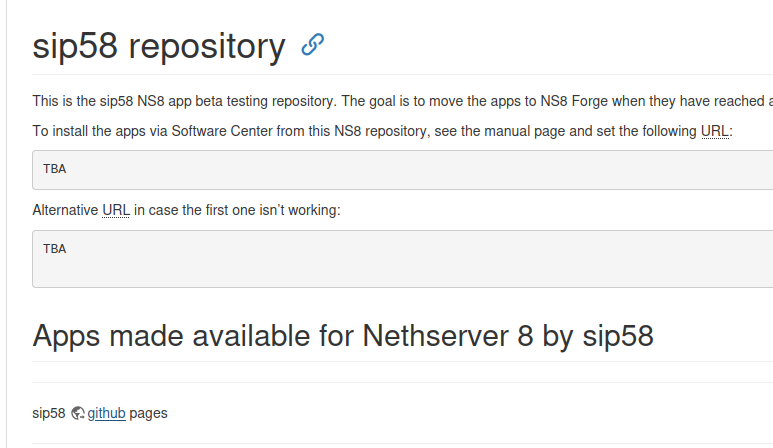
I think I misunderstood the process. I wanted to create a fork based on ns8-firebird…
This was the key word from you:
Now I understand, I need to fork the netforge repo to my own github account and then release my own module as a package and then it will be added to my netforge repo. Am I right?
I deleted the released version, I need to review it very carefully again. Maybe if you have the time, opportunity and desire, I would like to ask you to review it too, because more eyes see more… Then I will make it public and start testing again.
I’ve already checked the source code, I hope you can confirm that there is no problem with it…
How can I close some ports so that they don’t open again after an update or reboot? This is important because NS8 will be running on a server farm and there will be no router or other protection in front of it… I’m attaching a picture of it.
The firebird2 3050 port is closed when I stop the module, but - 3050 is still apparently open. The same situation occurs if I disable the port opening in the firewall in the firebird module settings. In all cases, - 3050 is still apparently open.
This is related to the publish command in the service file. Is port 3050 open or closed in this case? Could this cause a problem?
In principle, you can test the current version, it would be the final one, at most if we find a bug it will still need to be fixed.
I think the port was opened manually. The “-” means that it’s not part of a service. Following commands remove the port 3050, so disabling the open port in the firebird app settings should work.
Thank you very much. I opened it manually months ago for testing and forgot about it.
I didn’t notice that there was only one - entry under Service, the service is not named, while this is only there if we open it manually…
I’m sorry I was inattentive. That’s why I would have asked you to look at the source code and test the module, so that I don’t overlook something and there is an error in it…
I ask with respect because you know more about it than I do, is this necessary? Will anyone use it?
You should know that I create a database under Firebird with the Windows client program, not with the Firebird utilities. The same is true with saving and restoring existing databases.
Regardless of the Windows client program, you probably know that Firebird databases can be saved as files with copy-paste if the database server is not running, for example.
The idea seems useful and if you say that PR is justified then I will insert it right away, but I would like to understand why it is necessary.
Thank you very much for your suggestions and help.
Of course I merged the PR with the code. I understand the need for the optional and I don’t think it would cause a problem. I’ll test it, but if you have time, please test it yourself. Thank you.
I read @LayLow’s post about module certification options. I understand its significance and importance, but I simply don’t understand the process and method of implementation. Maybe my English is not good enough or I’m just old… Maybe I should let someone else release the Firebird module if I can’t solve it? I don’t even know who will test it according to the specification… I still have so many problems to solve before I can switch to running NS8 on a VPS and I’m not sure I’ll succeed, that I don’t know when I’ll get to the end if I’m stuck here…
I already tested the backup/restore process but I didn’t create or install databases.
There’s no hurry. It can be tested without a repository now by using the CLI.
When everything is working I’m going to support you with the certification/repo.
I’m trying to navigate the issue of releasing the application and module, but I’m still unsuccessful.
I need to create an application certificate for Firebird. The App Certification for NethServer 8 contains the information required to certify the module, but I don’t understand what to do with it. Should I write it down on a piece of paper, but what should I do with it?
I don’t understand it either, but it seems logical that Community (Level 1) might be the right one? The process and the certificate issuer are unknown to me…
This describes the community certification of the Application, it might help, but some parts of Platform compliancy are incomprehensible to me regarding Firebird.
It is also not clear how to proceed under Metadata and license and what to write in the referenced place regarding Firebird.
The final Firebird version should be released and an ns8 repository should be created for this, but I’m stuck with that too, because Create a ns8 repository for developers is just a series of images that I don’t fully understand and I can’t reproduce the operation…
I’m too old for this, I’d be happy to pass the credit on to someone else if they solve this and this version of Firebird continues to work…
Thank you for your interest @kemboielvis22 I’m working on it, but I haven’t had any success yet. For now, only my own github repo works, from where you can install it with the cli.
Is this my github page? Anyway, there is no page with that name, author, mine is sipi58. Can this be modified or will someone delete it and create a new one?
Once you are done with your repo on github and the module. The wiki will be done for you. Simply make a public announcement on the forums of the initial release of your module, and where the github pages are. Thanks.
While we are at it, reason for publishing an announcement with details is so that when the wiki would not be available, all details can still be found on the forums. The wiki listing is ‘just’ a central apps and repo directory, centrally maintained.