If you have flashed a custom rom on your phone, you already have adb installed since you need that to flash the rom.
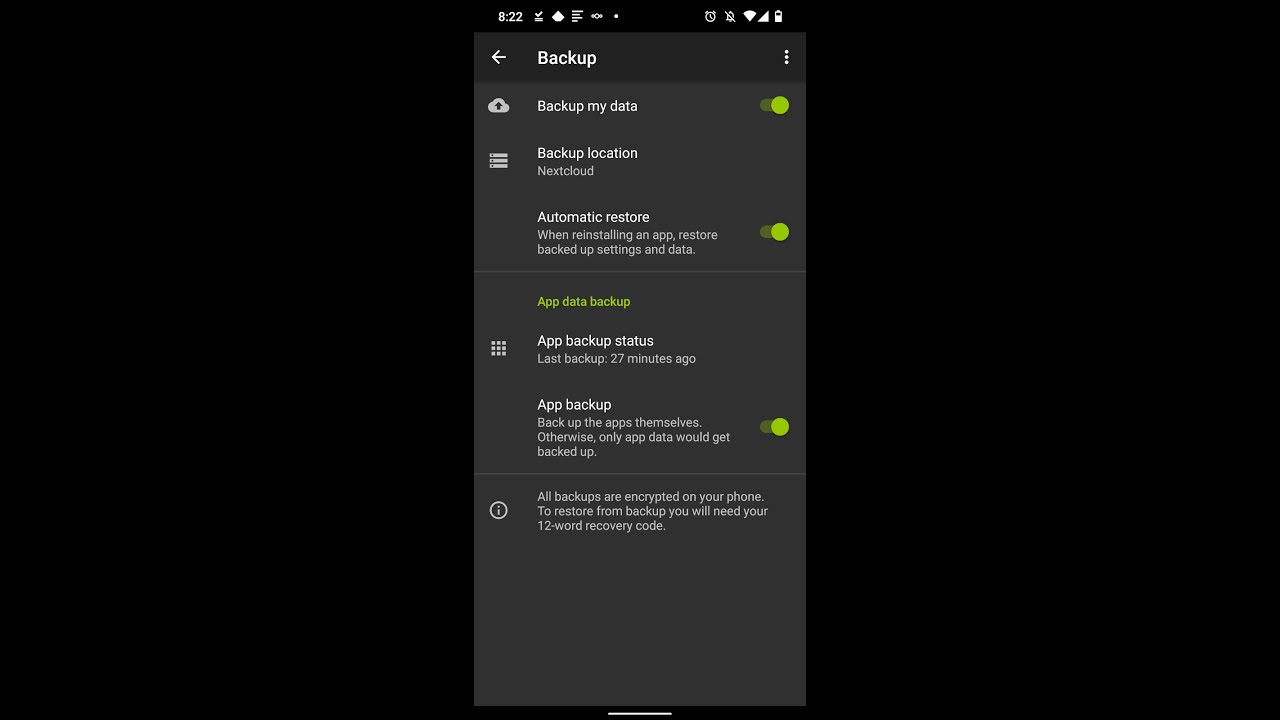
On your smartphone configure seedvault to use nextcloud as target:
Settings/System/advanced/backup. Since you already have the nextcloud app configured with your credentials, this is very straightforward. Nextcloud is available as a target, Click it and it is set. See this video:
When you configure seedvault, at a point you will see a 12 word passphrase. Note these and make sure to save them somewhere safe. It’s your only option to restore the data later. If you loose this passphrase, you will not be able to restore the backup!
Now do your backup by tapping the 3 dots on the top right corner and select ‘backup now’
When the backup is finished, you will see the backup in nextcloud as a hidden directory .SeedVaultAndroidBackup
Now the most important part: restore
Today I just did a factory reset to test the restore part. This has a few quirks but in the end I am quite pleased with the result.
When you do a factory reset, at some point you are prompted to do a restore. BUT… since you have backupped to nextcloud, and the phone doesn’t have a configured nextcloud client yet, this is like a catch22.
Luckily there is a way around this.
do the initial setup of Android, without restoring the backup.
Install f-droid, nextcloud client and configure nextcloud client with your nextcloud account.
configure seedvault. When the 12 word passphrase shows accept it. Then in the confirmscreen make sure to change the passphrase to the passphrase you used with the backup!
activate the developer options: go to settings/about this phone. scroll down and tap ‘Build number’ 7 times.
go back to settings. Go to System/Advanced/Developersoptions/Enable USB Debugging
Connect your phone to your pc using an USB cable
on your phone allow the pc to connect to your phone
open a terminal
start the restore procedure with this adb command : adb shell am start-activity -a com.stevesoltys.seedvault.RESTORE_BACKUP
Now the quirks (besides the way around direct restore during Android setup). There are quite some aps that don’t allow for backup. The configuration of those apps will not be restored. For example: I use k9 mail as mail IMAP client. The app doesn’t allow backup. So I had to reconfigure it manually after it was restored.
enjoy!
As an iPhone user, I have about 55% iPhone users and about 45% Android users among my clients.
All my iPhone clients, myself included use the built in Mail / Calender / Adressbook app.
My clients using Android about half use additional mail apps…
My question is why?
AFAIK, Android always includes two mail apps at start, a GMail mail programm and a generic mail app, which can handle IMAP and GMail…
And is the IMAP client so bad that a 3rd party Mail Client is needed?
Just out of interest, and to improve my capabilities / understanding for my clients…
Nethserver has the choice of 3 different flavours webmail clients. Why?
There are 3 different flavours of databases available for Nethserver. Why?
Should I go on?
The main reason for me to have a different app is simple: I don’t want apps with trackers in it. Just for the fun of it, install Exodus Privacy and check what trackers are ‘featured’ in the several apps in the Google Playstore. Don’t be surprised if there are several trackers in each app. Bluemail 4 trackers Cleanfox 6 trackers Outlook for Android 13! trackers yahoo mail 9 trackers
Just to give a few examples. That’s also why I use F-Droid to get my apps: no trackers!
If you install the exodus privacy addon in FF (or chrome/chromium plugin) you can browse the Google appstore and instantly see the amount of trackers each app has.
Not quite the same thing, neither NethServer nor the underlying databases are in the advertising business, nor do they operate trackers like Google does.
Android itself is a tracker, almost all Apps on the Playstore have “n” trackers installed…
Nothing surprising there… Google, and the obilgatory WhatsApp (found on almost all 'droids)
Worse than an Android phone / Tablett is an Android TV. After all, people expect a smartphone / tablett to have a camera built in. A lot will tape thier notebook cameras, but not on their smartphones…
But almost no one expects a TV to have a “hidden” Camera, and that is only there for spying on the home users… But it has been done…
Neither; AFAIK it’s a separate OpenPGP implementation.
That’s going to largely be driven by the requirements of the software that uses the database, right? I don’t expect there are many Neth users who want the database for the sake of the database (though it’s certainly there); I’d bet 99% of the database usage is to support some other software we provide (Nextcloud, WebTop, etc.)
Hence my call to quit using the Google playstore and switch to F-droid as playstore. BTW, the Apple appstore apps are also packed with trackers. Just recently Apple announced that tracking in apps will be opt-in (instead of opt-out as it was) and guess what: only 13% opts-in for tracking. Why: probably for a few reasons:
people are lazy and don’t change anything.
people don’t care
people have no clue
Android probably will never have such an opt-in since Google (much more than Apple) lives from ads.

 Google, and the obilgatory WhatsApp (found on almost all 'droids)